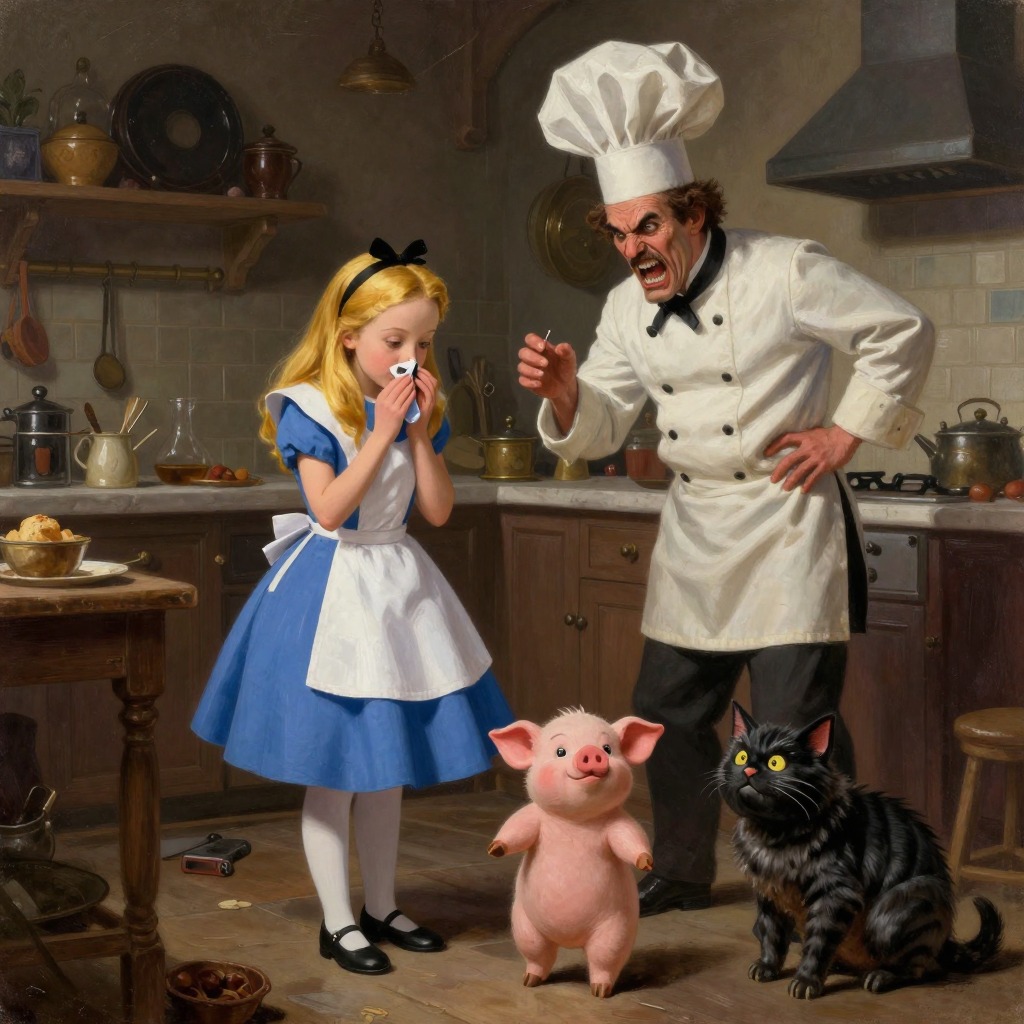
the Duchess's kitchen
The Duchess's kitchen is one of the most vividly chaotic interiors in Wonderland, a space where violence, noise, and absurdity converge to create a scene that is both terrifying and grotesquely comic. It is here that Alice, having left the argumentative Frog-Footman outside, steps directly into a world of domestic anarchy that will come to define her understanding of the place she has fallen into. The kitchen is not merely a room; it is a concentrated emblem of the arbitrary power, sensory overload, and logical inversion that govern Wonderland, and it leaves a lasting impression on Alice, who later reflects on its pepper-laden atmosphere as a possible cause of the Duchess's savage temper.
Setting and Atmosphere
The kitchen is described as being "full of smoke from one end to the other," a condition that immediately assaults the senses and sets the tone for the scene. The source of this smoke is a large cauldron of soup being stirred by the Cook, and the air is so thick with pepper that Alice can barely speak for sneezing. The pepper is not merely a seasoning but an active agent of chaos: the Duchess sneezes occasionally, the baby sneezes and howls "alternately without a moment's pause," and the only creatures in the room unaffected by the pepper are the Cook and a large cat sitting on the hearth, grinning "from ear to ear." This cat, later identified as the Cheshire Cat, is the sole calm presence in a room otherwise defined by violent motion and noise. The kitchen is also the site of physical aggression: the Cook, after taking the cauldron off the fire, begins throwing "everything within her reach" at the Duchess and the baby, including fire-irons, saucepans, plates, and dishes. The Duchess takes no notice of these missiles even when they hit her, and the baby's howling is so constant that it is impossible to tell whether the blows cause additional pain. The scene is one of complete domestic breakdown, where the normal rules of care and safety are suspended.
Key Characters and Their Roles
The kitchen introduces three figures who each embody a different aspect of Wonderland's absurdity. The Duchess is a volatile, authoritarian figure who nurses her baby while singing a lullaby that instructs the listener to "Speak roughly to your little boy, / And beat him when he sneezes," and who punctuates each line with a violent shake of the child. She is quick to anger, as when she responds to Alice's attempt at a scientific explanation about the earth's rotation by shouting "chop off her head!" Yet she is also capable of sudden, inexplicable shifts in mood, as when she flings the baby at Alice and hurries off to play croquet with the Queen. The Cook is a figure of relentless, mechanical violence, who throws objects without discrimination and seems entirely indifferent to the suffering she causes. The Cheshire Cat, by contrast, is a passive observer, grinning throughout the chaos, and its presence introduces the motif of the inexplicable and the uncanny that will recur throughout Alice's journey. The baby itself is a creature in transition, whose snorting, grunting, and increasingly pig-like features foreshadow its eventual transformation into a pig, a metamorphosis that Alice accepts with remarkable equanimity.
Alice's Experience and Reactions
Alice's entry into the kitchen is marked by a series of escalating confrontations with the illogic of the space. She is initially polite, asking about the cat's grin, but is met with the Duchess's brusque and nonsensical replies. When she attempts to demonstrate her knowledge by explaining that the earth takes twenty-four hours to turn on its axis, the Duchess responds with a non sequitur about axes and a threat of decapitation. Alice's attempts at reasoned conversation are consistently derailed by the Duchess's insistence on finding morals in everything, a habit that Alice finds both irritating and incomprehensible. The physical danger of the kitchen is real: Alice jumps up and down "in an agony of terror" as a large saucepan flies close to the baby's nose, and she is clearly relieved when the Duchess departs. Yet she also demonstrates a growing adaptability, catching the baby as it is flung at her and devising a method of holding it—twisting it into a knot and holding its right ear and left foot—that allows her to carry it outside. Her decision to take the baby away is motivated by a genuine concern for its welfare, as she thinks, "they're sure to kill it in a day or two: wouldn't it be murder to leave it behind?" This moment reveals a moral seriousness beneath her bewilderment.
Thematic Significance and Aftermath
The kitchen scene is a microcosm of the larger Wonderland, where violence is casual and arbitrary, logic is inverted, and the boundaries between the human and the animal are fluid. The pepper that fills the air becomes a symbol of the irritability and irrationality that pervade the realm, and Alice later reflects that "it's always pepper that makes people hot-tempered," a theory she develops as a kind of personal rule for understanding the world. The baby's transformation into a pig is the scene's most striking event, and it reinforces the theme of unstable identity that runs throughout the book: just as Alice changes size, so too does the baby change species, and Alice's matter-of-fact acceptance of this—"If it had grown up, it would have made a dreadfully ugly child: but it makes rather a handsome pig, I think"—shows how quickly she has adapted to the logic of Wonderland. The kitchen also introduces the Cheshire Cat, whose ability to appear and disappear at will and whose cryptic pronouncements will guide and confuse Alice in equal measure. The scene's influence extends beyond its immediate events: Alice later recalls the pepper when she is with the Duchess again in the croquet-ground, and the Duchess's habit of finding morals in everything becomes a running joke. In the sister's dream at the book's end, the kitchen is remembered as a place where "the pig-baby was sneezing on the Duchess's knee, while plates and dishes crashed around it," a final image of the chaos that Alice has left behind but that continues to reverberate in the memory of Wonderland.